
Treating workspace as a line in the burn rate fixes that. Buy what the next twelve months require, protect the option to grow, and avoid tying up cash that should be funding hires.
Stage one: pre-revenue or a single founder
Three things matter at this point: a licence, a credible address, and somewhere to work a few days a week. A private office is rarely one of them.
Your licence route shapes everything else. The Abu Dhabi Registration and Licensing Authority offers several routes that carry no premises requirement at the outset. The Freelancer Licence requires no office space. The Abu Dhabi Trader Licence, known as Tajer, requires no office lease initially. A Standard Economic Licence takes a different path, listing a lease agreement and Tawtheeq among its required documents.
Establish which route applies before you look at any workspace, because that single answer removes most options from consideration or puts them back on the table.
At this stage a flexible desk or virtual office with meeting room access usually covers the need. Treat year one as a test of the market rather than a statement of permanence.
Stage two: the first hires
Employment changes the calculation, because space and visas become linked.
The Ministry of Human Resources and Emiratisation sets visa quota against your establishment file, and licensing teams commonly work to a guideline of roughly one visa per nine square metres of office space. A founder planning four hires inside twelve months should size the space around that arithmetic before signing anything. Discovering the limit afterwards forces a move at the worst possible moment, usually just as the team starts working well together.
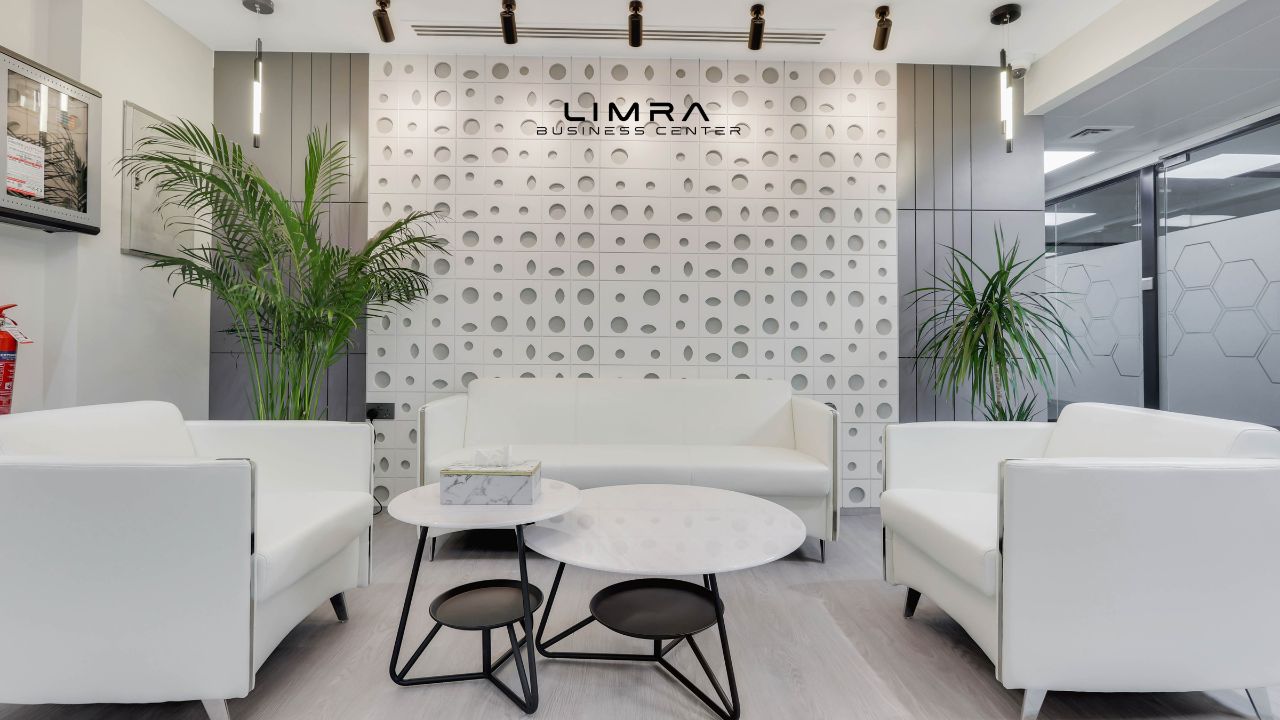
A small private office inside a serviced center tends to fit here. You get a lockable room, an address that supports the visa process, and furniture, connectivity and reception already in place. Nothing to fit out, nothing to connect, nothing stranded if the plan changes.
Stage three: funded and scaling
A team with capital raised and predictable headcount growth faces a genuine trade-off. Serviced space costs more per desk than a conventional lease. That premium buys flexibility, which is worth paying for while the organisation chart keeps moving.
The crossover arrives when headcount settles and your horizon stretches past two years. Before that point, adding a room next door without renegotiating anything usually beats the saving per square metre.
Serviced space works like a rental car. Nobody buys a vehicle for a journey whose length they cannot yet predict.
Worth knowing: conventional units are scarce. Citywide office vacancy sat near 1.4 percent in the second quarter of 2026, so the assumption that you can simply find a shell unit and fit it out deserves testing early.
Where the money actually goes
Founders compare monthly rates and miss the costs that decide the total.
A conventional lease carries fit-out, a security deposit, agency commission, utility connection through ADDC, service charges and Tawtheeq registration. Add the months of rent paid before anyone can work in the space. A serviced office folds most of that into one fee and starts producing value in days rather than months.
Five percent VAT applies to commercial rent either way, recoverable depending on your registration status.
Mistakes that drain early cash
Four patterns repeat across early-stage teams in the capital.
- Committing too long, too soon. A three-year lease signed in month two tends to outlive the plan behind it.
- Ignoring the visa arithmetic. Space that cannot carry your hiring plan forces an unplanned move.
- Paying for an address the customer never sees. Prestige matters in some sectors and not at all in others. Be honest about yours.
- Treating banking as an afterthought. Corporate account opening examines the substance behind an address closely, and a staffed center in a recognised building clears that scrutiny more smoothly than a mailbox arrangement.
A note on jurisdiction
Technology founders sometimes ask whether to base themselves in the emirate's financial free zone instead. That decision turns on who pays your invoices and who funds your growth: international investors and overseas clients often justify it, while a domestic customer base usually does not. Our guide to ADGM office space covers how that jurisdiction works if it applies to you.
For most startups selling into the UAE market, a mainland licence paired with a central Abu Dhabi address trades more freely and costs less.
How Limra supports early-stage teams
Limra Business Group operates serviced business centers in Al Najda, Al Nahyan and Electra, three central districts within easy reach of government service centers, banks and clients across the island. The group also manages more than 500 properties across the emirate.
Startups can begin with a virtual office or flexible desk and move into a private office in the same building as headcount grows, without changing address or restarting documentation. Tawtheeq registration, licensing support, PRO services and visa guidance sit with one team.
Before you commit to anything, we will tell you plainly whether the space you are considering supports the hiring plan you described.
Visit our Abu Dhabi business center to see what fits your current stage.
Frequently asked questions
1. What is the cheapest way for a startup to get office space in Abu Dhabi?
A flexible desk or virtual office at a serviced center, paired with a licence route that carries no premises requirement. Several routes from the Abu Dhabi Registration and Licensing Authority, including the Freelancer Licence and Tajer, require no office lease at the outset.
2. How much office space does a startup need for visas?
Licensing teams commonly apply a guideline of around one visa per nine square metres, with the Ministry of Human Resources and Emiratisation setting quota against your establishment file. Plan space around your twelve-month hiring target rather than current headcount.
3. Is a serviced office cheaper than leasing for a small team?
Over one to two years, frequently yes. A conventional lease wins on rate per square metre but adds fit-out, deposit, commission, utility connection and the months of rent paid before the space is usable.
4. When should a startup move from a desk to a private office?
Usually once three or four people need permanent seats, once hourly meeting room spend becomes routine, or once visa quota requires a defined space.